Did you ever wonder, "When did credit cards start and who was the first?"
Well sit back and ConnectedPay will tell you a little story.
The Origin of Payment Cards
The first payment card can be traced back to the local “Charg-It” card introduced by John Biggins in his Brooklyn neighborhood in 1946, the Franklin National Bank in New York formalized the practice by introducing the first bank-issued credit card in 1951. Over the next decade, several banks emerged in major cities to work with customer merchants to accept payment cards. However, this system limited consumers’ use of payment cards to an area restricted by the regional banks’ merchant customers.
The concept of a wider payment network was born in the mid-1960s when the InterBank Card Association (now MasterCard Worldwide) brought consistency to credit cards. InterBank developed payment network systems to process the exchange of funds between merchants and cardholders, standardized the billing process, and established rules and procedures to reduce fraud and other abuses.
The first debit transaction, using an automatic teller machine (ATM) card and personal identification number (PIN) to make a purchase at the point of sale (POS), occurred in the 1980s, and the first debit transaction authorized by a signature rather than a PIN was processed in 1988.
This history lesson compliments of MasterCard Worldwide
Tuesday, July 6, 2010
Monday, June 7, 2010
FAQ: What is cloud computing?
FAQ: What is cloud computing?
"Cloud computing refers to IT services that are purchased and delivered on demand over a network, either the public Internet or a private IP-based network. Cloud computing services are powered by highly virtualized processing and storage systems in data centers that are made available via a Web interface to remote users."
Cloud computing offers a business several advantages – including faster set-up, easier scalability and no capital expenditures for hardware and software. This is an attractive option for companies wishing minimize cash outflows. Some examples of cloud computing are Google Apps, Salesforce.com, and ConnectedPay.com. These services allow businesses to have the benefits of large network without the required capital investment, IT staff, and development time required to maintain the desired services. Google Apps allows users to share and edit basic office software tools over the internet. Salesforce.com offers a Customer Relationship Management suite that can be accessed by sales staff from home. ConnectedPay.com helps businesses accept online credit card payments for services rendered 24/7 even if the business isn't on the web.
Each of these services is dedicated to making business more efficient by providing their subscribers with powerful IT tools at a low cost. Cloud computing goes back to the term "re-inventing the wheel". Why should a business spend loads of money to create a static, in-house version of a service that is accessible anywhere there is an internet connection. Since hundreds/thousands of independent businesses are using the services, each service provider continues to develop more and more features which makes the product even more desirable.


Wednesday, May 26, 2010
More governmental regulation slated
| Per the Electronic Transactions Association: Senate Adopts Interchange Amendment |
| Despite success in getting the U.S. Senate to require 60 votes for passage, the Durbin interchange amendment to the financial reform bill was adopted by a 64-33 margin Thursday night. Sponsored by Sen. Richard Durbin (D-IL), the measure gives the Federal Reserve authority to regulate interchange fees on debit transactions, using a "reasonable and proportional" standard that gives the Fed plenty of room for interpretation. The amendment also allows retailers to use discounts to steer consumers to networks charging lower fees, to establish minimums and maximums for credit card purchases, and to offer cash discounts. If the Senate, as appears likely, passes the financial reform measure, it will have to be reconciled with a House version that does not include the Durbin provision. ETA Chief Executive Officer Carla Balakgie said, in a statement , that the association and its members were "disappointed" by the vote and "very concerned about the impact it will have on many types of businesses in the electronic payments chain." Connected Pay Q and A: Q: How will my business be affected by the Fed changing/influencing rates? A: Connected Pay clients do not need to worry about renegotiating rates as our rates move with interchange. You can feel comfortable knowing that as soon as the card networks adjust debit interchange lower, your rates will automatically move based on the Interchange + cost structure. Those merchants who are using the Connected Pay system with their old processor should consider discussing their rates with Connected Pay to ensure they receive the benefit of the decreased interchange rates. Q: What is the real life impact on my business of the financial reform? A: Connected Pay, in general, believes businesses will not be affected by the passage of this bill. Consumers may feel an impact of not being able to purchase certain goods due to a merchant requiring a specific dollar threshold to be met before a transaction can be processed. However, the majority of merchants know that if the consumer receives a positive experience through payment convenience, the merchant will benefit from the consumer's repeat business and most important, become a referral source for the merchant. |
Monday, May 17, 2010
Get PCI Compliant by July 1, 2010
According to Visa, merchants, service providers and their agents are required to use payment applications that support the Payment Card Industry Data Security Standard (PCI DSS), by July 1, 2010 in an effort to mitigate emerging security risks.
Privacy Rights Clearinghouse.org noted more than 234 million records with sensitive information have been
breached since January 2005.
DON'T WAIT UNTIL JULY 1, 2010!!!!!!!!!!!!!
Becoming PCI compliant shouldn't be a burden. Click here for the self assessment questionnaire.
If you want Connected Pay to do the work, we offer a product called CertifyPCI™. This product was designed specifically to streamline the PCI Certification process in an effort to help merchants easily achieve a higher level of security. CertifyPCI™ is an automated web based process to PCI certify qualified merchants in minutes. Innovative Self-Assessment Questionnaire (SAQ) selection procedure to make sure the appropriate document is chosen for merchants.
After all of the questions have been correctly answered, the merchant will be able to generate a pdf that attests to their certification.
They can also place a seal on their web page that attests to their PCI Certification.
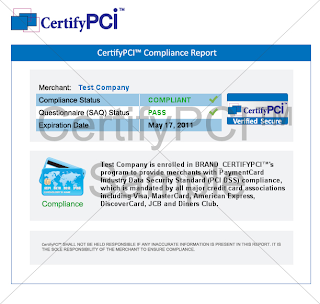
When consumers click on the seal, the following image is presented:
Additionally, the Customer Vault on the gateway offered by Connected Pay can help make your organization PCI compliant if you are storing card data on internet facing IP addresses.
Contact Connected Pay today to take advantage of our quick and easy PCI Certification tools.
Contact Us. Services.
Privacy Rights Clearinghouse.org noted more than 234 million records with sensitive information have been
breached since January 2005.
DON'T WAIT UNTIL JULY 1, 2010!!!!!!!!!!!!!
Becoming PCI compliant shouldn't be a burden. Click here for the self assessment questionnaire.
If you want Connected Pay to do the work, we offer a product called CertifyPCI™. This product was designed specifically to streamline the PCI Certification process in an effort to help merchants easily achieve a higher level of security. CertifyPCI™ is an automated web based process to PCI certify qualified merchants in minutes. Innovative Self-Assessment Questionnaire (SAQ) selection procedure to make sure the appropriate document is chosen for merchants.
After all of the questions have been correctly answered, the merchant will be able to generate a pdf that attests to their certification.
They can also place a seal on their web page that attests to their PCI Certification.
When consumers click on the seal, the following image is presented:

Additionally, the Customer Vault on the gateway offered by Connected Pay can help make your organization PCI compliant if you are storing card data on internet facing IP addresses.
Contact Connected Pay today to take advantage of our quick and easy PCI Certification tools.
Contact Us. Services.
Tuesday, May 4, 2010
Client Spotlight - Faulkner's Ranch

Connected Pay picked up an interesting client yesterday. Faulkner's Ranch. They host Corporate events, such as company picnics and team building; Weddings; Birthdays; Pony Programs; and a they have a huge pumpkin patch. Look forward to this fall when Benjamin Ranch becomes HAUNTED!
Faulkner's Ranch is located at:
10600 Raytown Rd. Kansas City, MO 64134
816-761-5055


www.faulknersranch.com
For the past 25 years, Kansas City’s legendary Benjamin Ranch has been a labor of love for the entire Faulkner Family. Keeping Kansas City’s old western “Cowtown” tradition alive is a life-long mission in the Faulkner Family beginning in 1955 with “Faulkner’s Western
Why Have a Practice Web Page?
From by LARRY EMMOTT - Emmott on Technology
"Web pages are not just about attracting new patients.
Even more important is a major trend toward using web pages for a lot more than basic contact information. For example; recently I was having trouble setting up a new feature on my cell phone. I could have tried to find the owners manual. I could have taken it into the store where I bought it. I could have asked a friend how to do it. I could have phoned an 800 number and waited on hold. I could have done many things to solve my problem. However what I did do was go to the Internet.
I googled the companies web page, I located my phone model and opened up complete instructions on how to take care of my problem. In just a few minutes it was done. While I was on the web page, I could have chosen several new ring tones, ordered some accessories or checked my account balance.
A practice web page is not just an electronic yellow pages ad. A web page should provide service for existing customers as well as attracting new patients."
Examples of services for existing patients are allowing for patients to make payments online, appointment reminders, and refer a friend links.
Examples of services for new patients are electronic forms, service offering, financing methods, and doctor/staff profiles.
Tuesday, April 27, 2010
Interchange updated for Visa and Mastercard
Merchants may have noticed on their statements a notification stating that the card associations were adjusting their rates.
For merchants processing with Connected Pay's interchange plus pricing, in general their rates will not be affected. Connected Pay's merchant base interchange fees were unchanged from the October 2009 rates.
Interchange Rates:
Visa - http://usa.visa.com/merchants/operations/interchange_rates.html
MasterCard - http://www.mastercard.com/us/merchant/support/interchange_rates.html
Many card providers offering a tiered structure (Qualified, Mid Qualified, Non Qualified) use the card association adjustment to increase possessing fees. Merchants with a tiered pricing structure should consider negotiating with their current processor to get to an interchange plus structure, such as the one Connected Pay offers.
For more information on Connected Pay click on the links below:
Subscribe to:
Posts (Atom)